01
Base prep on clay
We moisture-condition, compact, and grade the base over Blackland clay so the load spreads out evenly and the pad doesn't rise or drop as the soil drinks in and gives up water beneath it.
A pad sized to exactly what it has to hold, reinforced for the weight on top and based for the shrink-swell clay below, so it stays level instead of lifting or sinking as the seasons turn.
Credibility comes from how it's built, not from promises. Here's the order of operations on every concrete pads & slabs job.
We moisture-condition, compact, and grade the base over Blackland clay so the load spreads out evenly and the pad doesn't rise or drop as the soil drinks in and gives up water beneath it.
Thickness tracks whatever the pad ends up holding. A shed footprint and a shop floor parked under trucks and gear are a long way from the same pour.
Reinforcement is fitted to the job, running from mesh on light pads up to a rebar grid where heavy loads sit or where the slab has to span movement in our expansive ground.
Beneath an enclosed or finished pad we lay down a vapor barrier so moisture in the ground stays put and can't wick up into the concrete.
We place a well-proportioned mix, saw in the control joints, and keep a cure going so the afternoon heat can't draw the early strength back out of the surface.
Most contractors vanish after the deposit. We pick up the phone, show up when we say, and stand behind the work after the truck leaves. The follow-through is the difference.
A foreman we know runs your job and a vetted crew does the work, managed by Lucky's, one company accountable from the first call to the final walkthrough.
COI and lien waivers on file before we break ground. The documentation that lets commercial clients pay and gives homeowners peace of mind.
Prepped subgrade, reinforced and mixed to spec for the job, and proper curing. We build credibility through the process, not promises. On concrete pads & slabs, that starts with base prep on clay.
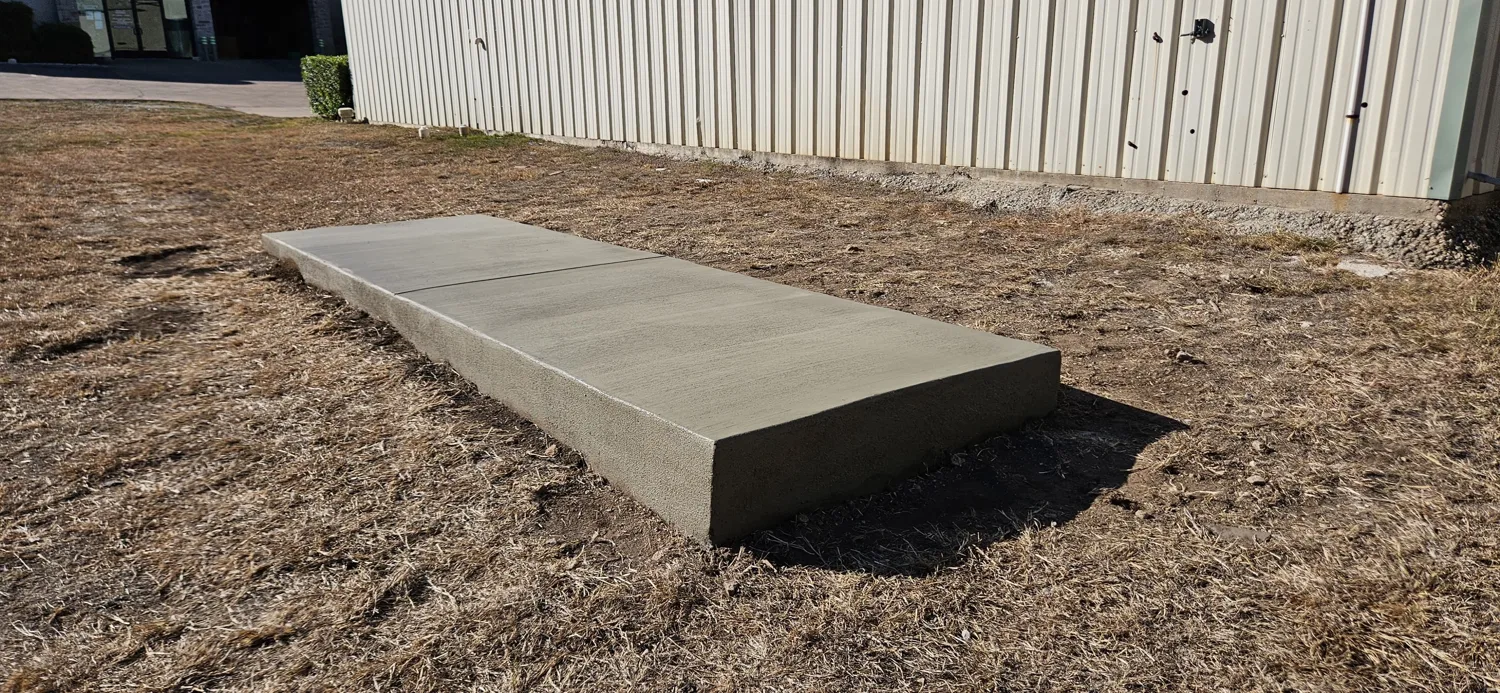
A pad in North Texas takes its price from the load above and the soil below: reinforcement fitted to the use, a compacted base over expansive clay, and a cure that stands up to the summer sun. As a fair starting point, most pads and slabs land around $7 to $13 per square foot, moving with thickness and whether the build needs a vapor barrier. We size and quote each one against the weight it is going to carry.
The load makes the call. A shed pad asks much less than a garage or shop floor sitting under trucks and equipment, so we set the thickness and the steel to your real use and to the expansive clay underneath it.
Yes. Each one is heavy and drives its weight through a handful of points, so we deepen the pour and step up the steel. A hot tub especially wants a level, reliable base that won't lean or settle as the clay works, so the groundwork matters every bit as much as the slab itself. Tell us the equipment and we shape the pad to it.
For an enclosed or finished slab, usually yes; the barrier blocks ground moisture from creeping up through the concrete. We weigh it case by case against what the slab is going to be used for.
Some do, depending on the size, the location, and the use, and rules in one North Texas town don't always line up with the next. We point it out when a permit looks likely, so it is squared away ahead of the pour instead of after.
Concrete carries on gaining strength long after the top looks done. We give you a firm date to put equipment on your specific pour, with the week's heat worked into it.
You'll hear back from a real person, usually the same day. No call center, no runaround, no chasing us down.
Booking up fast this season. Or call (737) 258-4735